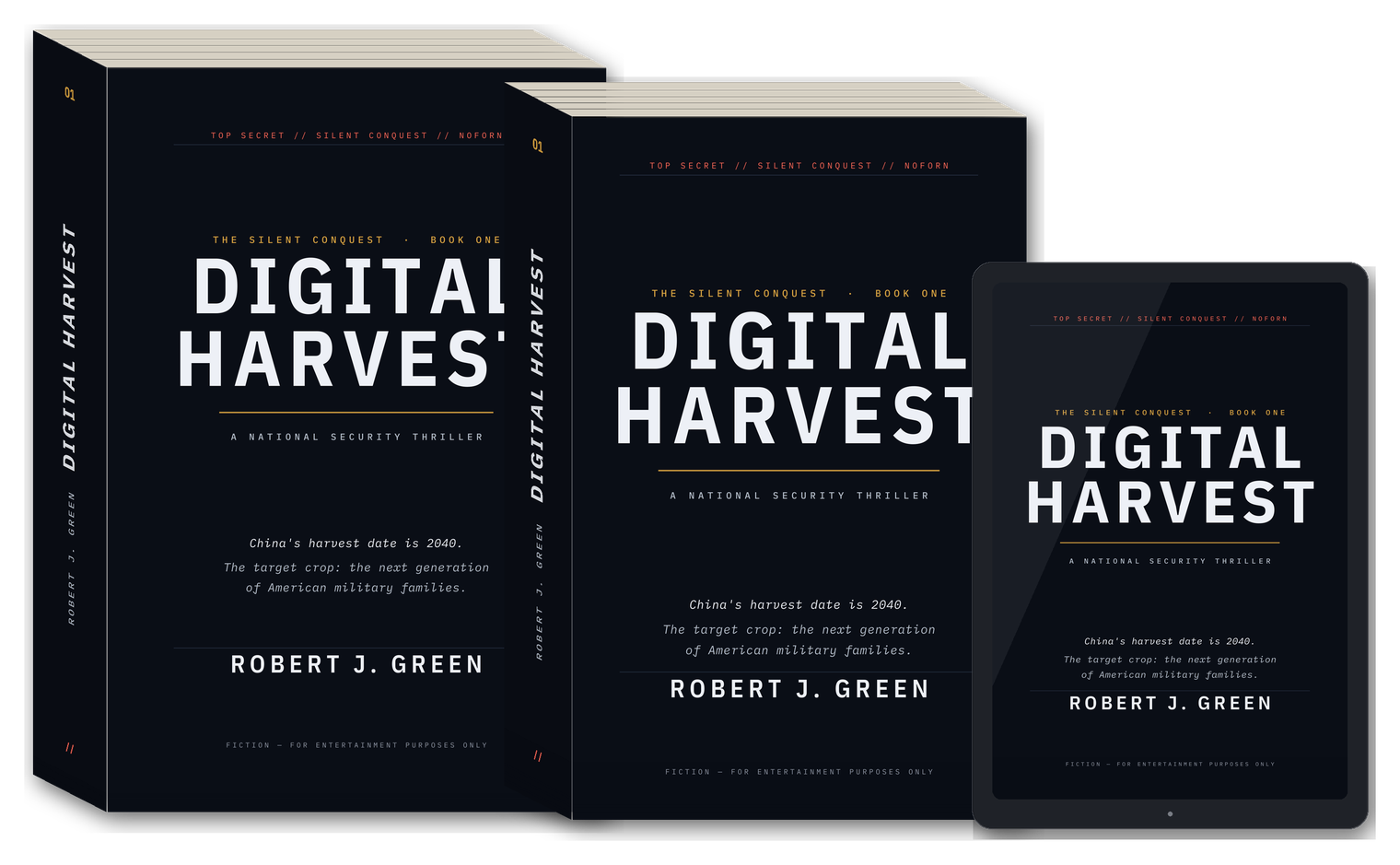
What if the apps teaching your children math, music, and social skills were listening to every word spoken in your home, and had been for eighteen years?
China's harvest date is 2040.
The target crop: the next generation of American military families.
When MIT economist Marcus Webb discovers that Chinese state-backed funds have spent four hundred million dollars purchasing farmland within surveillance range of every nuclear weapons facility in America, his analysis triggers a cascade of revelations across five strangers, each independently holding a piece of the same terrifying puzzle.
A CIA analyst tracing impossible financial patterns through twenty-three shell companies. A defense contractor whose AI detection system finds ghost radar signatures the Air Force's own filters are designed to miss. Wei Zhang, a Chinese-American animator in Sunnyvale, who discovers surveillance code hidden inside the children's games she helps create, and mails a handwritten letter to the FBI. And a retired Army colonel who has been watching his neighbor's property for fourteen months with binoculars and a composition notebook, waiting for someone to believe him.
What they uncover is an eighteen-year operation targeting thirty million American families through the educational apps their children love: apps that fund their own surveillance through advertising revenue, making them the world's most profitable spy network. Overhead, nuclear-powered drones launched from those purchased farms photograph America's nuclear deterrent with technology the Pentagon doesn't know exists.
No government agency connected the dots. Five civilians did.
The clock is ticking. China's harvest date is 2040.
The target crop: the next generation of American military families.
Digital Harvest is the story of what it cost five ordinary people to make a government listen, and what it cost them personally when it finally did.
The Five · Personnel Overview
The Americans meets Tom Clancy's Jack Ryan, with the financial sophistication of John le Carré and the institutional realism of The Looming Tower.
Digital Harvest is written for readers who have read the best in the genre and know when something is authentic: readers who recognize real tradecraft, institutional friction, and operational realism that isn't borrowed from Hollywood.
If You Read These, This Is for You
Crossover Audiences
The Silent Conquest · Series Architecture
Digital Harvest is the first book in a four-novel arc following a single Chinese strategic program from its origins in agricultural surveillance to its endgame in economic conquest. Each book stands alone. Together they document the full scope of modern conquest through commerce rather than conflict.
Agricultural surveillance · Nuclear drone ISR · The discovery
European operations · Evolved architecture · The escalation
Global network revealed · Taiwan integration · The crisis
Five Pillars endgame · Lu Kai's gambit · The reckoning
Adaptation
The series is architected for adaptation as an 18-24 episode premium streaming series, built on the same moral complexity and authentic tradecraft that defines the best work in the genre.The novel is the briefing. The Vault is the source material: twelve authentic-format intelligence documents from the agencies inside Digital Harvest. National estimates, findings, and technical assessments. Read the operation the way the analysts did.
Enter the Intel Vault →Lifetime Access · $9.99 · Instant PDF Delivery · Every File Is a Work of Fiction

The analytical framework in The Silent Conquest series is built on real supply chain vulnerability research, conducted entirely from publicly available government data. The same methodology that powers the fiction produced findings that stand on their own. These articles present the nonfictional distillation of that research.
RJGreenResearch.org
The global economy has assembled a system of mutual supply chain dependency that mirrors the logic of nuclear deterrence, without doctrine, red lines, or stabilizing architecture. An introduction to Mutual Threshold Saturation and the 1,637 single-source dependencies no one had previously counted.
Github Repository for all Projects and Papers
Social Science Research Network
Existing single-sector risk frameworks systematically underestimate compound cascade risk because they cannot identify interactions among simultaneously stressed dependencies across sector boundaries. This paper introduces Mutual Threshold Saturation (MTS), a formal framework for compound supply chain vulnerability analysis that operationalises cross-sector dependency enumeration, identifies cascade pathways between sectors, and quantifies temporal exploitation windows — the lag between dependency identification and domestic capacity restoration. The framework is applied to seven critical sectors: pharmaceuticals and medical supply, critical minerals and semiconductors, fertilizer and agricultural inputs, energy and battery systems, telecommunications, domestic food supply concentration, and physical infrastructure.
Working paper
Social Science Research Network
Using USDA AFIDA primary data (2020–2024), this paper applies Monte Carlo permutation testing to agricultural holdings from 11 investor countries, geocoded to county centroids against 221 CONUS military installations from the CFIUS Appendix A database. The central finding is comparative: Chinese holdings cluster at 2.4 times random expectation within 50 miles of installations (p < 0.001), compared to an allied-nation baseline of 1.8 times. Acreage-weighted analysis yields 3.58 times enrichment, indicating the dominant land mass is disproportionately proximate. Panel analysis (2022–2024) reveals Chinese-attributed acreage expanded 2.0 per cent and county presence grew 9.4 per cent during active state-level restrictions — expansion and diffusion, not selective divestment. A Part 3 ICBM missile field analysis finds 704 foreign holdings in 42 of 48 missile field counties, with Chinese-linked holdings present in Weld County, Colorado (90th Missile Wing field). All data and code are available at https://github.com/rjgreenresearch/afida-spatial-analysis.
Working paper
Social Science Research Network
he United States maintains three separate systems for tracking who owns its agricultural land: the USDA's Agricultural Foreign Investment Disclosure Act (AFIDA) database, the SEC's EDGAR filing system, and 50 independent state Secretary of State corporate registries. None of these systems communicates with the others. This paper measures the visibility gap that results.
Working paper
Social Science Research Network
This paper assesses how effective the U.S. Committee on Foreign Investment in the United States (CFIUS) is at reviewing foreign purchases of agricultural land near military installations, using Chinese-linked agricultural holdings as a test case.
Working paper
Methodology Note
All research is derived from publicly available U.S. government reports, congressional testimony, international organization publications, and open-source trade data. No classified materials were referenced. A companion research paper with full methodology, sector-by-sector enumeration, and multi-country analysis is available upon request. Every factual claim is independently verifiable.